

Skip to content
Man smiling looking up to the right

PAPZIMEOS may give patients the chance to have more surgery-free time

PAPZIMEOS is recommended as a first-line treatment for newly diagnosed adult patients with recurrent respiratory papillomatosis (RRP).
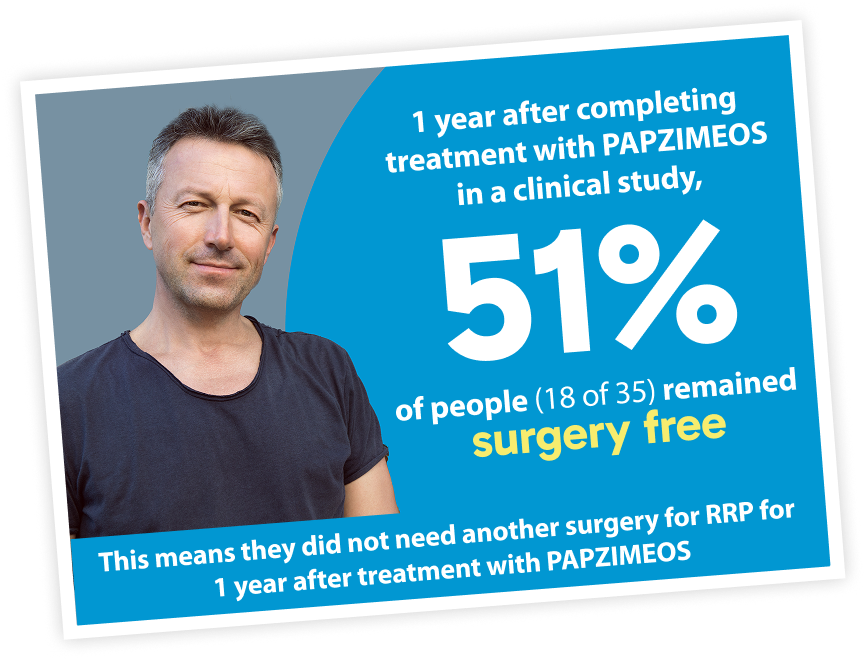
Man smiling with statistic that says 51% of patients who took PAPZIMEOS were surgery free 1 year after completing treatment (primary endpoint)

Not an actual patient.

PATIENTS FINISHED TREATMENT AND WERE FOLLOWED FOR 12 MONTHS


Year 1

OVER HALF HAD 0 surgeries

People with RRP went from having at least 3 surgeries per year before taking PAPZIMEOS to an average of 0 surgeries in the year after finishing treatment

Year 2

MOST PATIENTS THAT HAD
0 SURGERIES AT YEAR 1 WERE

STILL
SURGERY
FREE

AFTER 2 YEARS

Year 3

MOST patients that were surgery free after 2 years were

STILL
SURGERY
FREE

AFTER 3 YEARS

14 of 18 patients remained surgery free after 3 years of follow-up. One patient has not yet reached 3 years of follow-up

In the safety evaluation of 38 patients, side effects included pain, redness, or swelling where the shot was given, feeling tired, chills, fever, muscle aches, feeling sick (nausea), headache, increased heart rate, diarrhea, vomiting, and sweating a lot.

THERE WERE 70% FEWER SURGERIES OVERALL 1 YEAR AFTER TREATMENT WITH PAPZIMEOS.

In the year before treatment with PAPZIMEOS, there were a total 151 surgeries for all 35 patients in the trial. In the year after completing treatment with PAPZIMEOS, there were a total of 45 surgeries in some of the patients.

The most common side effects for PAPZIMEOS included*:

  • Pain, redness, or swelling where the shot was given
  • Feeling tired
  • Chills
  • Fever
  • Muscle aches
  • Nausea (feeling sick)
  • Headache
  • Increased heart rate
  • Diarrhea
  • Vomiting
  • Sweating a lot

*Safety evaluation included all 38 people with RRP studied who received PAPZIMEOS. 35 people in the clinical study received the recommended dose of PAPZIMEOS.

No patients in the clinical trial had to stop taking PAPZIMEOS early due to side effects

Most adverse reactions happened after the first dose of PAPZIMEOS and usually lasted 1-3 days.

In people who took PAPZIMEOS, the most common adverse reactions were mild to moderate and mostly resolved on their own.

These are not all of the possible side effects of PAPZIMEOS. Call your healthcare provider for medical advice about side effects. You are encouraged to report negative side effects of prescription drugs to the FDA. Visit www.fda.gov/medwatch, or call 1-800-FDA-1088. You may also report side effects to Precigen, Inc. at 1-855-PGE-NRRP (1-855-743-6777).

Experts supported by the RRP Foundation

recommend PAPZIMEOS for adults with RRP who want to break the cycle and reduce their number of surgeries.

The goal of RRP treatment has evolved its focus from managing symptoms to helping patients have fewer surgeries, which may help patients avoid potential complications due to additional surgeries.

Not an actual patient.

Want to learn more about PAPZIMEOS?

Sign up to get the latest information and connect with a Papzimeos SUPPORT representative.

*Required field.


What is PAPZIMEOS?

PAPZIMEOS is a type of immunotherapy used to treat a condition called recurrent respiratory papillomatosis (RRP) in adults.

Important Safety Information

What is the most important information I should know about PAPZIMEOS?

Some people may have a reaction to the shot. Signs and symptoms may include redness, pain, swelling, itching, or warmth where the shot was given. After your first treatment, your healthcare provider will watch you for at least 30 minutes to make sure you're feeling okay.

Please contact your doctor immediately if you develop an infection, the reaction to your shot worsens, or you experience any of the below symptoms, which may indicate a systemic allergic reaction:

  • Difficulty breathing
  • Widespread rash
  • Facial swelling

Thrombotic events (blood clots that block your blood vessels) may occur after your PAPZIMEOS shot. Please notify your doctor immediately if you have the following symptoms:

  • Shortness of breath
  • Chest pain
  • Leg swelling
  • Persistent abdominal pain
  • Severe or persistent headaches
  • Blurred vision

What should I know before taking PAPZIMEOS?

Before taking PAPZIMEOS, tell your healthcare provider about all of your medical conditions, including:

  • If you are pregnant or plan to become pregnant because it is not known if PAPZIMEOS will harm the unborn baby.
  • If you are breastfeeding or plan to breastfeed. It is unknown if PAPZIMEOS is present in breast milk, or how it affects the breastfeeding child or milk production. Talk to your healthcare provider about the best way to feed your baby during treatment with PAPZIMEOS.

What are the most common side effects of PAPZIMEOS?

The most common side effects include:

  • Pain, redness, or swelling where the shot was given
  • Feeling tired
  • Chills
  • Fever
  • Muscle aches
  • Nausea (feeling sick)
  • Headache
  • Increased heart rate
  • Diarrhea
  • Vomiting
  • Sweating a lot

These are not all of the possible side effects of PAPZIMEOS. Call your healthcare provider for medical advice about side effects. You are encouraged to report negative side effects of prescription drugs to the FDA. Visit www.fda.gov/medwatch, or call 1-800-FDA-1088. You may also report side effects to Precigen, Inc. at 1-855-PGE-NRRP (1-855-743-6777).

Please see full Prescribing Information.

What is PAPZIMEOS?

PAPZIMEOS is a type of immunotherapy used to treat a condition called recurrent respiratory papillomatosis (RRP) in adults.

Important Safety Information

What is the most important information I should know about PAPZIMEOS?

Some people may have a reaction to the shot. Signs and symptoms may include redness, pain, swelling, itching, or warmth where the shot was given. After your first treatment, your healthcare provider will watch you for at least 30 minutes to make sure you're feeling okay.

What is PAPZIMEOS?

PAPZIMEOS is a type of immunotherapy used to treat a condition called recurrent respiratory papillomatosis (RRP) in adults.

Important Safety Information

What is the most important information I should know about PAPZIMEOS?

Some people may have a reaction to the shot. Signs and symptoms may include redness, pain, swelling, itching, or warmth where the shot was given. After your first treatment, your healthcare provider will watch you for at least 30 minutes to make sure you're feeling okay.

Please contact your doctor immediately if you develop an infection, the reaction to your shot worsens, or you experience any of the below symptoms, which may indicate a systemic allergic reaction:

  • Difficulty breathing
  • Widespread rash
  • Facial swelling

Thrombotic events (blood clots that block your blood vessels) may occur after your PAPZIMEOS shot. Please notify your doctor immediately if you have the following symptoms:

  • Shortness of breath
  • Chest pain
  • Leg swelling
  • Persistent abdominal pain
  • Severe or persistent headaches
  • Blurred vision

What should I know before taking PAPZIMEOS?

Before taking PAPZIMEOS, tell your healthcare provider about all of your medical conditions, including:

  • If you are pregnant or plan to become pregnant because it is not known if PAPZIMEOS will harm the unborn baby.
  • If you are breastfeeding or plan to breastfeed. It is unknown if PAPZIMEOS is present in breast milk, or how it affects the breastfeeding child or milk production. Talk to your healthcare provider about the best way to feed your baby during treatment with PAPZIMEOS.

What are the most common side effects of PAPZIMEOS?

The most common side effects include:

  • Pain, redness, or swelling where the shot was given
  • Feeling tired
  • Chills
  • Fever
  • Muscle aches
  • Nausea (feeling sick)
  • Headache
  • Increased heart rate
  • Diarrhea
  • Vomiting
  • Sweating a lot

These are not all of the possible side effects of PAPZIMEOS. Call your healthcare provider for medical advice about side effects. You are encouraged to report negative side effects of prescription drugs to the FDA. Visit www.fda.gov/medwatch, or call 1-800-FDA-1088. You may also report side effects to Precigen, Inc. at 1-855-PGE-NRRP (1-855-743-6777).

Please see full Prescribing Information.